
Analysis of the development and market prospects of floating pv system
 Publish Time:2021-12-16
 Sources:garcesolar
With the rapid development of the photovoltaic industry, its application fields are becoming more and more extensive, and water photovoltaic is one of them. Because it does not occupy land resources, and has the advantages of high power generation and high added value, aquatic photovoltaics are regarded as the "most effective lever for accelerating the transition to solar-driven future" in the new energy utilization model. This article analyzes the development status of the world and China's floating photovoltaic industry, and analyzes the market prospects.
Concept and type
Floating photovoltaic power plants refer to lakes built in ponds, small and medium-sized natural lakes, reservoirs, and water storage ponds, where coal mining subsidence areas form lakes. As a new utilization method of photovoltaic power generation, water photovoltaic power plants are mainly divided into fixed pile foundation and floating type according to different foundation types. The fixed pile foundation water photovoltaic power station is mainly in the form of "fixed pile foundation + fixed support", supplemented by "fixed pile foundation + tracking support"; floating water photovoltaic power station can be divided into floating tube type and floating tube type. However, the actual type of hydro-PV power plant is usually determined by the depth of the water. In shallow water, that is, when the water depth is less than or equal to 3m, the fixed pile foundation can be used; in the deep water area, that is, the water depth is >; 3m, the runoff is stable, and the water level generally changes; the floating type can be used for 6m.
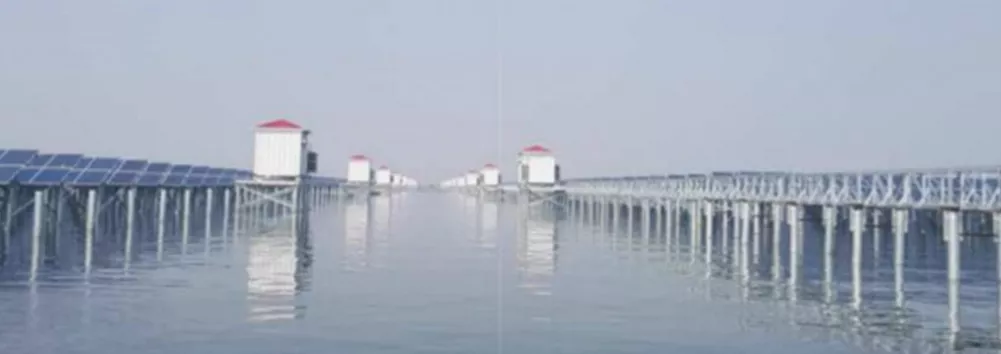
Fixed water photovoltaic pile foundation
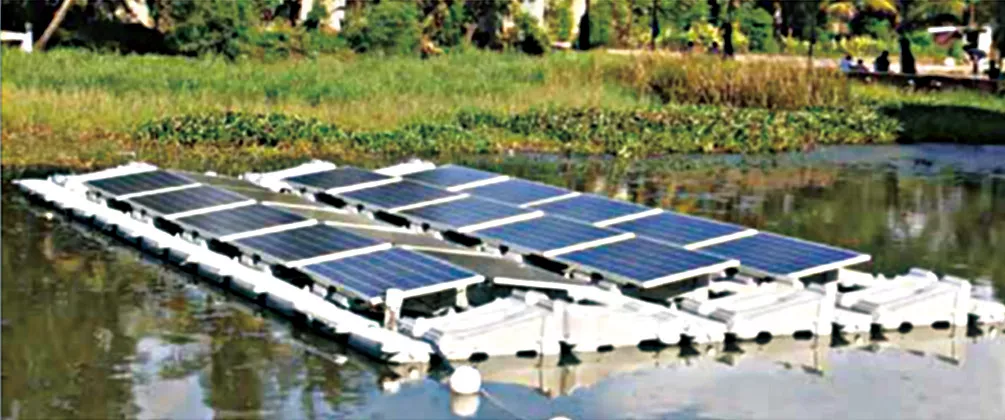
Water photovoltaic floating type
The advantages of floating photovoltaic power plants are mainly reflected in the following points:
(1) Large power generation. On the one hand, because the water surface is relatively open, the negative impact of shadows on the power generation of photovoltaic modules can be avoided. For double-sided photovoltaic modules, the reflectivity of the water surface is much greater than that of the ground and mountain surfaces; on the other hand, the water surface has a cooling effect and can be effective Reduce the working temperature of the photovoltaic module, thereby reducing the temperature loss of the photovoltaic power generation system. In general, the working temperature of photovoltaic modules on the water surface is about 5°C lower than that on the ground. Therefore, compared with ground-based photovoltaic power plants under the same conditions, the power generation of floating photovoltaic power plants is about 5% to 7%.
(2) Does not occupy land resources. Since the floating photovoltaic power station is built on the water surface, it does not occupy land resources and has little impact on the ecological environment of the water body, avoiding the land use problem of ground photovoltaic power stations. It is a good choice to develop photovoltaic projects in countries and regions with dense populations, limited land resources but abundant water resources.
(3) Easy to integrate with other industries. Aquatic photovoltaics can give full play to the advantages of the "photovoltaic +" model, deeply integrate photovoltaic power plants with aquaculture, and increase commercial benefits. On the one hand, the cover of photovoltaic modules can reduce the evaporation of water, and the blocked sunlight can reduce photosynthesis, thereby inhibiting the growth of algae; on the other hand, photovoltaic power plants can provide electricity for auxiliary aquaculture equipment, such as aerators. This not only reduces the cost of power grid infrastructure construction, but also increases aquaculture production, thus increasing the added value of the overall business model.
Problems and challenges Compared with ground-based photovoltaic power plants, the on-site environment of water-based photovoltaic power plants usually has the characteristics of high humidity, salt fog, gusts and waves. Photovoltaic modules, floating platforms and electrical equipment are all easily damaged. Therefore, the water photovoltaic power station puts forward higher quality requirements for the weather resistance and reliability of the equipment. Regarding the site conditions of fixed-pile-based photovoltaic power plants, the soil at the top of the underwater bottom is usually a silt layer, which has poor surface stability, weak bearing capacity, difficult positioning, and slow construction. It is impossible to use heavy machinery for large-scale construction; for floating water Photovoltaic power plants face construction safety risks due to more diving or shipboard operations.
In addition, the floating objects used in the power station also need to consider environmental protection requirements and a 25-year service life. In addition, although the water surface environment can reduce dust pollution to the module, it is convenient for the cleaning of the module, and effectively prevents people and animals from damaging the module. The power station may cause garbage deposition, and due to uncertain factors such as dry and wet periods, strong wind cooling, etc., the water surface conditions will change, which will affect the operation and maintenance personnel to enter the power station and increase the difficulty of operation and maintenance.
In order to adapt to the water surface environment and reduce the failure rate, in the process of design and application, the photovoltaic modules selected for the floating photovoltaic power station should have the ability to resist potential induced attenuation (PID), salt spray corrosion and low moisture permeability; the floating body requires a low density , In addition to strong load-bearing capacity and long service life, it also requires the ability to resist ultraviolet radiation, corrosion, frost expansion, and wind and wave; the bracket should be made of strong and anti-corrosive materials; electrical equipment such as combiner boxes, inverters, and transformers The dustproof and waterproof grade should be improved (at least IP65), and have corrosion resistance.
According to research data, the available area of global water photovoltaic is about 404.5 thousand km2. Calculated based on 1% of the development volume, the development potential of water photovoltaics is at least 400 GWP. Since the application of the world's first commercial water photovoltaic project in the United States in 2008, the application scale of the world's water photovoltaic industry has continued to expand, and has entered an exponential growth stage since 2017. As of May 2019, 353 water photovoltaic projects have been built globally, with a cumulative installed capacity of 1.4 GWP. At present, a market pattern with Asia as the center and small (below 2mwp) and floating photovoltaic power plants has been formed. In the future, the floating photovoltaic industry will develop in the direction of scale expansion, cost reduction, and technological progress.
Well-known companies put forward the concept of "intelligent solutions for large-scale ground photovoltaic power plants", adopting the mode of "intelligent combiner box + box-type inverter room for water photovoltaics", which has the three characteristics of "non-immersion, wireless communication, and flexible wiring". Power generation is higher, safer, more reliable, and less investment. A number of well-known companies put forward the concept of "co-building Splendid Photovoltaic", develop complementary fishing and photovoltaic power stations, realize underwater aquaculture and underwater power generation, and rely on the big data cloud service platform to carry out all-round remote monitoring and special management to ensure the reliable operation of the system.