
The design and type of ground photovoltaic power Mounting
 Publish Time:2021-12-17
 Sources:garcesolar
Reasonable photovoltaic support can improve the system's ability to withstand wind and snow loads. Reasonable use of the load-bearing characteristics of the photovoltaic support system can further optimize its size parameters, save materials, and help further reduce the cost of the photovoltaic system.
The loads acting on the photovoltaic module supports mainly include: the self-weight (constant load) of the Mounting and photovoltaic modules, wind load, snow load, temperature load and seismic load.Wind loads play a controlling role. Therefore, the foundation design should ensure the stability of the foundation under wind loads. Under the action of wind load, the foundation may be pulled up, fractured and other damage phenomena, and the foundation design should ensure that it is not damaged under this force.
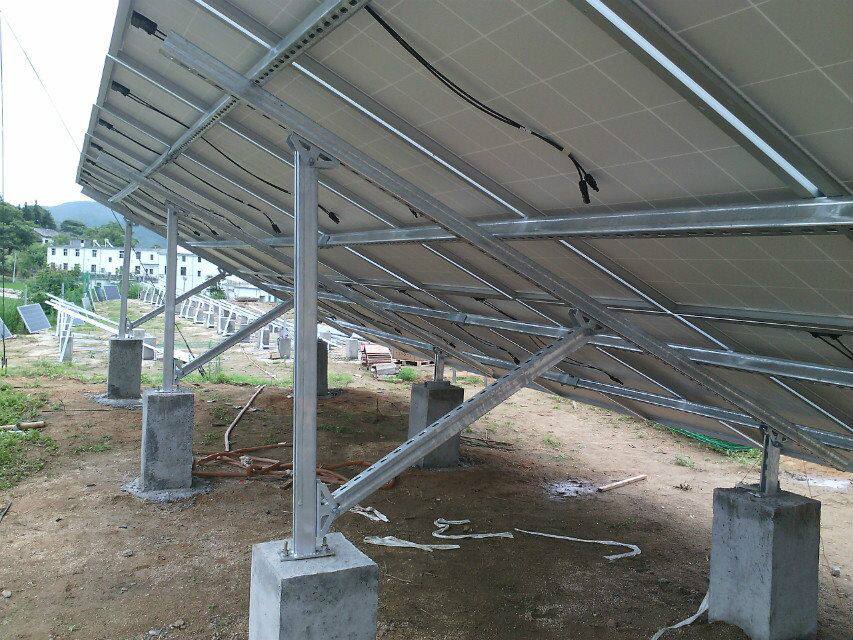
Let us understand the following different types of ground photovoltaic Mounting types and their characteristics:
Foundation type: According to different geological conditions, there are various forms of photovoltaic Mounting foundation. According to the load transfer form, the PV Mounting foundation mainly includes the extended foundation, the pile foundation and the anchor foundation. When selecting the type of Mounting foundation, not only the support form must be satisfied to meet the load conditions and service requirements, but also the geological and hydrological conditions must be considered.
Because photovoltaic power plants generally have grid connection time node requirements and a short construction period, the rapidity and convenience of construction technology should also be considered when basic type selection, as well as economic indicators and environmental protection requirements.
The expansion foundation generally adopts cast-in-place concrete. If on-site pouring or winter construction is not convenient, you can also consider factory prefabrication to reduce on-site wet work and maintenance. The expansion foundation has a large bottom area, low foundation pressure, high rigidity and good integrity. It has good adaptability to the settlement and deformation of the foundation. It is suitable for special geological conditions such as soft soil area, coal mining subsidence area, collapsible loess area, and newly backfilled loose soil. However, expansive foundations require a large amount of excavation and high cost; damage to surface vegetation and morphology is not conducive to ecological environment protection; construction in areas with high groundwater levels is difficult.
Therefore, there are fewer applications in ground photovoltaic power station Mounting. Pile foundations include concrete cast-in-place pile foundations, concrete precast pile foundations, steel pile foundations, etc., which are currently the most widely used form of Mounting. When the photovoltaic Mounting adopts a pile foundation, generally no bearing platform is set. The pillar is connected to the foundation by inserting, welding, embedding anchor rods, flanges, etc., or directly adopts the integrated form of pile and column; the cast-in-place pile foundation adopts mechanized hole formation ; Convenient construction, low labor consumption, little damage and disturbance to the topsoil, and can penetrate hard soil layers. The height of the top surface of the foundation can be adjusted to adapt to the undulating terrain.
Due to the small diameter of cast-in-place pile foundation piles, dry construction is generally used, and the conditions of no-hole collapse should be met during the hole forming process. It is not suitable for soft soil, loose sand, gravel soil and sites with high groundwater level. Cast-in-place concrete requires cast-in-place piles, which are difficult to repair in winter construction and should not be used. The foundation of precast concrete piles can be prefabricated in the factory and mass-produced. No excavation is required on site. The construction speed is fast. No maintenance is required in winter. The pile quality is good. The elevation of the pile top can be adjusted according to the undulation of the ground. Anti-corrosion additives can be added as needed during factory production, which has good durability. Suitable for cohesive soil and silt sites. In the gravel stratum, pile driving is difficult, and eccentric or broken piles are prone to occur, so it is not suitable to be used.
The prefabricated pile foundation is also suitable for offshore tidal flats, "fish and light complementary" and other aquatic photovoltaic power plants. The construction of precast concrete piles relies on pile driving or pile pressing machinery, which is suitable for relatively flat sites and not suitable for photovoltaic power stations in mountainous areas. In remote areas, transportation costs also need to be considered. The anchor bolt foundation is composed of rock-soil bolts and concrete load-bearing platforms or cross-section steel load-bearing slabs. There are two types of bolt support on the rock foundation: it is an embedded bolt support foundation. Drill holes in the rock and anchor the bolts in the rock by pouring adhesive; the other is the rock bolt foundation, which uses rock drilling equipment to form holes, pour mortar or fine aggregate concrete, and anchor the bolts. The anchor bolt foundation is suitable for shallow buried or directly exposed rock sites. The degree of rock weathering should be moderate weathering, and the degree should be relatively complete.
It should not be used when there is underground water. The stress analysis and design of the ground photovoltaic Mounting is closely related to the Mounting form of the upper photovoltaic module. At present, the commonly used brackets are fixed, angle-adjustable, horizontal single-axis tracking, inclined single-axis tracking, etc. The fixed bracket can be in two forms, double-column and single-column, and other brackets generally use single-column. The loads acting on the Mounting are mainly permanent loads, wind loads and snow loads. When transferred to the top surface of the foundation, they are mainly vertical loads, horizontal loads and bending moments.